

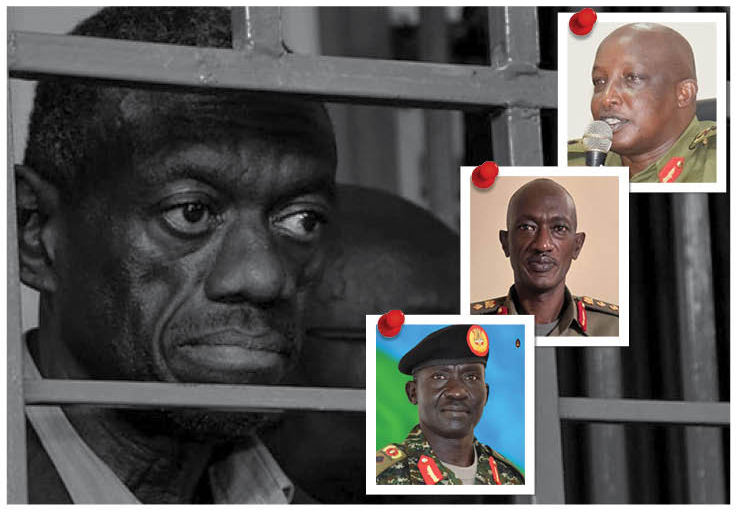
The decision to line up serving and former heads of Uganda’s military intelligence apparatus in the treason prosecution of Kizza Besigye has pushed the case into a more complex legal and political space than a standard criminal trial.
The prosecution intends to call current Defence Intelligence and Security chief Richard Otto, as well as two former spymasters in Abel Kandiho and James Birungi - the latter currently in jail on corruption and abuse of office charges.
It raises harder questions about the nature of the case, the quality of the evidence, and the boundaries between intelligence work and criminal proof.
At a legal level, there is nothing irregular about intelligence officers testifying in a civilian High Court.
Under Uganda’s Evidence Act, any competent witness may testify, and military status does not grant immunity or special restriction. The shift of the case from the General Court Martial to the High Court following the Supreme Court’s 2025 ruling simply confirmed that civilians must be tried in civilian courts.
It does not limit who may give evidence. In that narrow sense, the presence of senior military officers is legally proper.
However a more central question is what kind of case this is becoming. Treason under Section 23 of Uganda’s Penal Code Act (Cap. 120) requires proof of acts or conduct aimed at overthrowing government or levying war.
That normally demands overt acts, material steps, or demonstrable preparations such as recruitment, weapons acquisition, financing, or operational coordination. The witness list, however, suggests something different: a prosecution heavily dependent on intelligence reconstruction of alleged intent and activity.
That creates a structural tension in the case. Intelligence agencies like the Chieftaincy of Military Intelligence and its successor DIS are not designed to produce courtroom-grade proof. Their function is preventive, not adjudicative.
They assess threats, aggregate information from informants, surveillance, and intercepts, and produce security judgments. The prosecution’s reliance on Otto, Kandiho, and Birungi therefore signals that much of its narrative may rest on classified assessments and intelligence summaries rather than independently verifiable acts.
The legal risk in that approach is not admissibility alone but evidential weight. Courts can hear intelligence-derived testimony, but conviction for treason requires proof beyond reasonable doubt, not security suspicion.
Defence lawyers are likely to press hard on whether the state is presenting intelligence inferences as if they were criminal facts, and whether the chain from raw intelligence to final allegation is transparent, testable, and open to effective cross-examination.
That issue becomes sharper when considering continuity. The alleged conduct spans 2023 to 2024 and multiple jurisdictions including Uganda, Kenya, Switzerland, and Greece.
No single intelligence chief covers that entire timeline. The prosecution’s structure appears designed to solve this gap by layering testimony: Otto for institutional continuity in the present, Kandiho for operational intelligence in the middle period, and Birungi for earlier assessments.
In theory, this creates a seamless intelligence narrative. In practice, it risks exposing the case to fragmentation if the defence succeeds in showing inconsistencies between institutional accounts.
The most legally sensitive figure in this chain is Birungi. Unlike the others, he is in detention on his own serious charges.
That fact does not disqualify him as a witness under Ugandan law. However, it fundamentally alters how his testimony will be treated in court. A witness facing their own prosecution introduces a credibility variable that cannot be ignored.
Even without proof of a formal deal, the incentives are obvious. The defence will likely frame his testimony as either self-serving or transactional, particularly if any part of the prosecution narrative depends heavily on his account.
This is where the “deal” question arises. There is no public evidence of a cooperation agreement. But in legal and political practice, especially in high-stakes security prosecutions, such perceptions matter almost as much as facts.
If a detained former intelligence chief provides testimony that strengthens the state’s case, while simultaneously seeking relief in his own matter, the defence does not need to prove an explicit arrangement to raise doubt.
The mere alignment of incentives becomes part of the credibility challenge.
There is also the unresolved question of institutional accountability. Both Kandiho and Birungi were central figures in Uganda’s intelligence structure during periods now under scrutiny. That raises a structural paradox: the same institutions that allegedly generated intelligence on Besigye are now being asked to validate their own assessments in court.
This blurs the line between investigation and self-confirmation, a point defence teams are likely to exploit by arguing that the prosecution is effectively calling the intelligence system to testify on its own conclusions.
The transition from court martial to civilian court adds another layer.
Besigye was initially processed in the General Court Martial before the Supreme Court ruled that civilians cannot be tried in military courts. That ruling did not erase prior proceedings, but it raises questions about how evidence generated during that phase is being repackaged.
Practically, the appearance of military officers in civilian court is straightforward: they testify under oath, are cross-examined, and are subject to the same evidential standards as any other witness.
Symbolically, however, it is far more loaded. In a politically sensitive case involving a long-standing opposition figure, the presence of senior intelligence officials inevitably raises questions about institutional neutrality, especially in a system where security agencies have historically been central actors in political enforcement.
Ultimately, intelligence can point to patterns, suspicions, and networks. Criminal conviction requires something more rigid: verifiable acts, tested credibility, and evidence that survives adversarial scrutiny without relying on institutional authority alone.